

5 Important Lessons I Learned About Money in 2025
A year of giant holes in the yard, hard truths, and unexpected financial wisdom

In 2025, my wife and I took on a big (for us) home equity loan to build a 170 ft.² addition onto our house. One night I remember slumping against a cabinet on my kitchen floor as my wife and I realized we were way short on cash for this renovation. The hole had already been dug.

She was, understandably, pissed at me for not thinking through all the costs, for applying my habitual bright-side-of-life disposition to renovating a 200-year-old brick house. What could go wrong?
I learned a lot about money in 2025 and I suspect next year I will, too. As Alvy Singer in the movie Annie Hall says, a relationship is like a shark; If it stops moving, it dies. And whether we like it or not, we all have a relationship with money that has to keep moving, because our goals and circumstances are always changing.
So, here are the five most important things I learned about money in 2025:
1. Pessimism Can Pay off (Sometimes)
One of the things my wife is good at is anticipating the ways a project could go badly. I’ve theorized about why she leans this way when it comes to money and why I’ve tended to assume that most money problems will go away… eventually… somehow.
The first lesson is that when taking on a complicated project of uncertain length, like moving to a new home, adopting a pet, or God forbid a DIY home improvement project, assume that the costs will be higher than you expect. Depending on your psychology, you may imagine that this enterprise will go smoothly and stay on budget. Don’t fall for it.
When it comes to funding something like a big vacation or starting a business, you’ll be so much happier at the end if you look on the stormy side of life. Ask yourself, am I ready for unforeseen problems to emerge? Can I pay for them?
Don’t assume the best case scenario. Put that money aside now before you’re slumped on the kitchen floor wondering how you’re going to afford $3,000 of that beautiful paneling you thought you just had to have. At “worst,” you won’t end up needing the extra money and can put it to use on your next goal.
2. Focus on What You Can Control
It was about April of this year when Tariff-mania seized my news outlets. This, in case you don’t remember, is how the stock market was feeling when it seemed like supply chain chaos and a recession was around the corner.
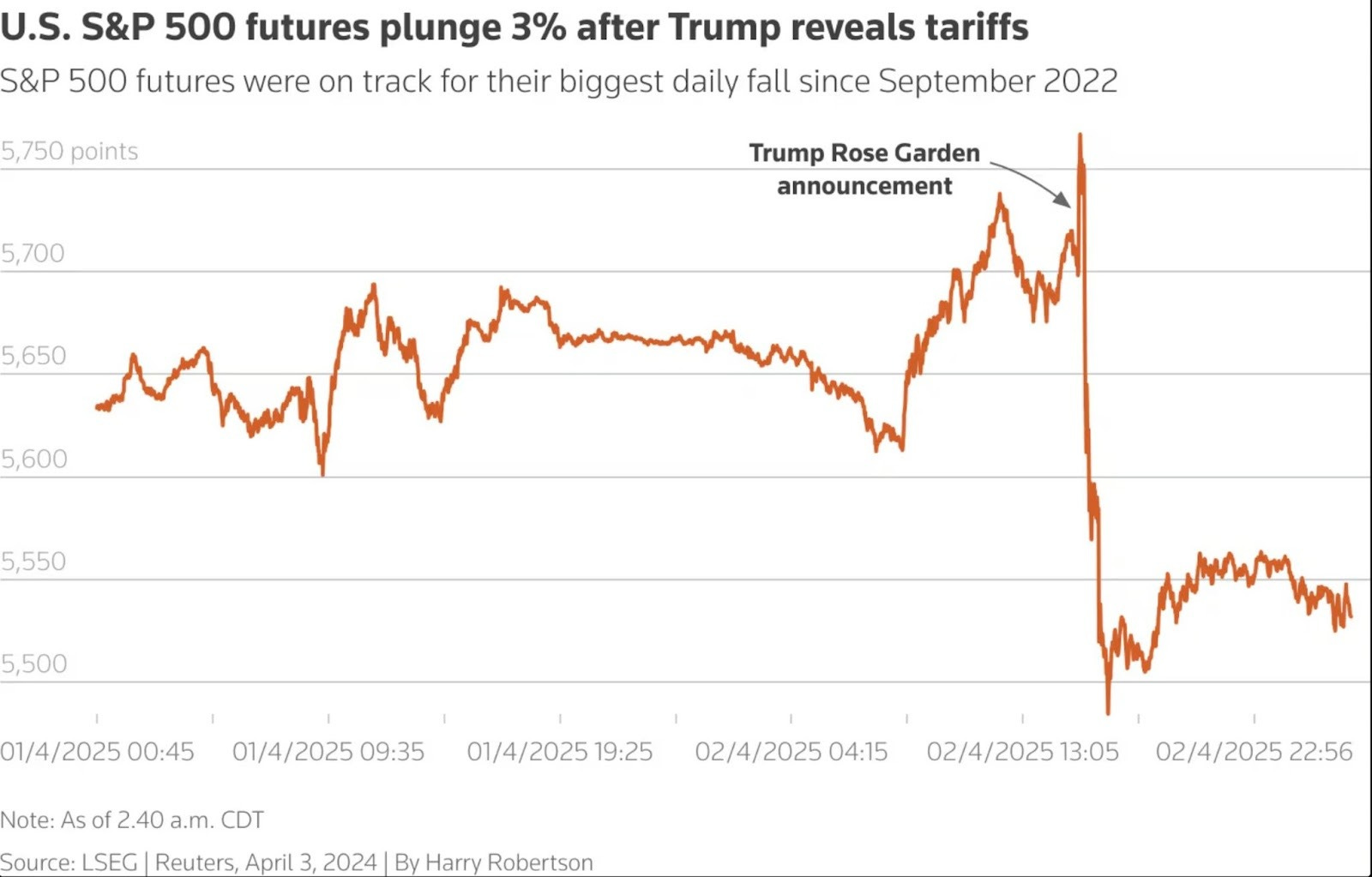
Anxiety wafted through the public radio broadcasts and many of my friends and family were spiraling into a panic loop: prices will skyrocket > consumers will stop buying stuff > economy will fall over > jobs will be lost > feudalism.
But it didn’t happen, at least as completely and disruptively as many feared. To me, the lesson is not that big, bad macroeconomic events won’t happen—they will—but you and I can’t control them no matter how frequently we refresh The Wall Street Journal home page.
I learned to redirect some of my attention from macroeconomics to the micro-economy happening in my household. I assessed the money going to our non-negotiables like our mortgage, utilities, healthcare, and I looked at what we could cut in a pinch. (Here’s a helpful guide from my colleague Ben on how to do this.)
Like a surfer in a churning sea, I learned to find relative stability on my small board in an otherwise choppy situation.
3. People Can Spend Money on the Same Thing for Different Reasons
I read a very illuminating book (which I’ll write about more later) called The Price You Pay for College by The New York Times personal finance columnist, Ron Lieber. Among the many outrageous things I learned about our dysfunctional higher education landscape, one thing was clear: every parent and child is operating with different priorities and circumstances. College is not one-size-fits-all.
But Lieber’s project is even broader: to remove a sense of shame for parents who can’t pay upwards of $360,000 for four years of college and to lessen the pressure for students who fear that success is only possible if they can crack the code and get into a tiny number of elite schools.
After reading The Price You Pay for College, I felt more okay that my wife and I don’t have hundreds of thousands of dollars lying in wait for our kids’ college. I now feel confident that our daughters, should they wish to attend college, will be a part of honest conversations about what we can afford, the trade-offs of loans, and what is our goal for higher ed? At the end of the day, your financial priorities are about making the best decision for you, not imitating the herd.
4. Money Is Meant to Be a Conversation
One of the coolest things I saw this year was Sherry, a YNABer in her 70s getting her first tattoo next to her son, Michael, at YNAB Fan Fest in Minneapolis. It was a gathering on the banks of the Mississippi River in an old industrial building with several hundred YNABers. There was so much joy in the air. Why? Because when money is stripped of worry and taboo, you’re suddenly excited to talk about it. Money touches everything, so when you’re good with money, your life can really change.

5. Sleep on It
A blogger from simpler times on the Internet (circa 2009), Leo Baubata of Zen Habits, used to tell people to wait until the first of the month for discretionary purchases like books, clothes, music, home goods, etc. But this had nothing to do with waiting for payday.
It was a mindfulness practice that gives your brain a chance to reflect: is this really how I want to spend X dollars? (Your money is finite; remember that.) Once the initial excitement and lusting for gratification fades, you’ll know if those jeans or that novel is something that has lasting interest for you. But if, as is usually the case after a couple days or a week, the luster has faded, you haven’t lost anything; you’ve only gained the money to now spend on something you really do care about.
Over the summer, my wife and I were briefly enthralled with the idea of putting in some paneling in our living room wall during the reno. A designer friend mocked it up and showed how charming it would look. We had mentally said, yes, let’s do it, but the contractor was slow to give us the quote and when it came in at $3,000, we almost went ahead on sheer momentum.
But after about a week of letting the decision sit, we realized there were so many other things ahead of paneling that we wanted to spend that $3,000 on. We passed, and I bought a fancy can of paint for about 60 bucks and I almost never think about the paneling that could have been.
In talking about this post with someone who used to work in retail, she told me that two pieces of advice for people struggling with compulsive shopping are:
Take whatever you want to buy at the store and ask a salesperson to put it on hold for you overnight. They can almost always do this.
When shopping online, add the item to your cart and then close your browser. Sleep on it and see if the purchase still calls you the next day.
This is what I should do with the leftover apple crumb pie from Thanksgiving that I’m still ravaging — wait a bit instead to see if I’m actually hungry.
But I refuse.
I’m willing to be good with money and bad with pie.
As always, I’d love to hear from you in the comments: What did you learn this year about money?
Until next time,
Dan
When I was “bad with money” (I much later learned it was ADHD impulse control issues) I had a rule for things I didn’t need. If I visited that shirt at the gap three times, I could buy it. That applied to all things, but that shirt from the gap when I was in my 20s is one I still remember at 62, definitely a worthwhile purchase after three visits.
I have recently (a few months ago) started doing the 'put it in the cart, close the browser' experiment. It works! Opening up LL Bean and seeing I have 3 items in the cart. Opening Thriftbooks and remembering the 2 books I wanted to read at one point. It's kind of revelatory!